1922 Wheat penny value remains one of the most debated topics in the Lincoln cent series. The year looks simple, but actually, it is not. Every cent was struck at Denver. Yet some coins show no mint mark. Others show a weak “D.” A small group shows a strong reverse with no mint mark at all. Prices range from a few dollars to tens of thousands.
Here we would like to compare all major 1922 varieties. It explains how to identify them and where real premiums begin.
For quick sorting, tools like Coin ID Scanner can help confirm date, mint, composition, weight, and type from a photo. The app provides a coin card with technical data and an estimated value range. Its database covers more than 187,000 coins. Use it for initial checks and read the article to know further details.
Why 1922 Is Different
In 1922, the Philadelphia Mint did not strike Lincoln cents. All business strikes came from the Denver Mint. Every genuine 1922 cent was produced in Denver.
That fact defines the year. If a 1922 cent has no visible mint mark, it was not struck in Philadelphia. Something happened during production.
Heavy die wear and aggressive die polishing reduced raised design elements on the die. Because the mint mark was a raised feature on the working die in 1922, over-polishing gradually removed the “D” mint mark from the die surface itself. This created the famous “No D” variety.
Main Characteristics
| Feature | Detail |
| Year | 1922 |
| Mint | Denver only (D) |
| Composition | 95% copper, 5% tin, and zinc |
| Weight | 3.11 g |
| Diameter | 19.05 mm |
| Edge | Plain |
The coin is bronze. It is not steel, not clad. Copper composition allows color designations: Brown (BN), Red Brown (RB), and Red (RD). Color affects price in higher grades.
The Four Main Categories
Not every 1922 cent is equal. The market recognizes four major groups.
1922-D Strong Reverse (Normal Issue)
This is the standard issue.
Characteristics:
- Clear “D” mint mark.
- Strong reverse details.
- Normal strike quality for the year.
Most 1922 cents fall into this category.
Market Prices – 1922-D Strong Reverse
| Grade | Typical Value |
| G4 | $8–$15 |
| F12 | $18–$30 |
| VF20 | $35–$50 |
| XF40 | $70–$110 |
| AU50 | $150–$250 |
| MS63 BN | $400–$600 |
| MS65 BN | $1,000–$1,800 |
This variety is not rare. It is popular because of the date, but the supply is strong. Value rises with preservation.
But red examples are scarcer than others. MS65 RD coins can exceed several thousand dollars.
1922-D Weak D
Here, the mint mark is faint or partially visible.
Cause:
- Die deterioration.
- Grease filling around the mint mark.
- Worn dies late in production.
Collectors often mistake this for the No D variety. It is not the same.
The reverse is often weak as well. Lettering may lack sharpness.
Market Prices – 1922-D Weak D
| Grade | Typical Value |
| G4 | $10–$18 |
| F12 | $25–$40 |
| VF20 | $45–$70 |
| XF40 | $90–$150 |
| AU50 | $200–$350 |
Premium is moderate. The weak mint mark alone does not create rarity. Condition remains the main factor.
1922 No D – Weak Reverse
This variety shows no visible mint mark. However, the reverse is also weak.
This happened because of die pair issues. Excessive die wear caused the mint mark and reverse details to fade.
Collectors recognize this as a separate variety. It is scarcer than normal 1922-D coins, but not the rarest of the year.
Market Prices – No D Weak Reverse
| Grade | Typical Value |
| G4 | $400–$700 |
| F12 | $700–$1,200 |
| VF20 | $1,200–$2,000 |
| XF40 | $2,000–$3,500 |
| AU50 | $4,000–$6,000 |
Even in low grade, value jumps sharply compared to regular issues. Color matters at higher grades. Red examples are extremely scarce.
1922 No D – Strong Reverse (Key Variety)
This is the real key issue.
Characteristics:
- No visible mint mark.
- Strong, sharp reverse.
- Clear Wheat lines and lettering.
The reverse strength separates it from the weak reverse type. This distinction is critical.
Collectors pay a major premium for this variety.
Market Prices – No D Strong Reverse
| Grade | Typical Value |
| G4 | $800–$1,500 |
| F12 | $1,500–$2,500 |
| VF20 | $2,500–$4,000 |
| XF40 | $5,000–$8,000 |
| AU50 | $9,000–$14,000 |
| MS63 BN | $20,000–$30,000+ |
At higher Mint State levels, auction records have exceeded six figures for top examples.
1922 Wheat penny value increases dramatically for the No D strong reverse variety. This is the coin most collectors seek.
How to Tell Them Apart
Accurate identification determines value. A small detail can change the price by thousands.
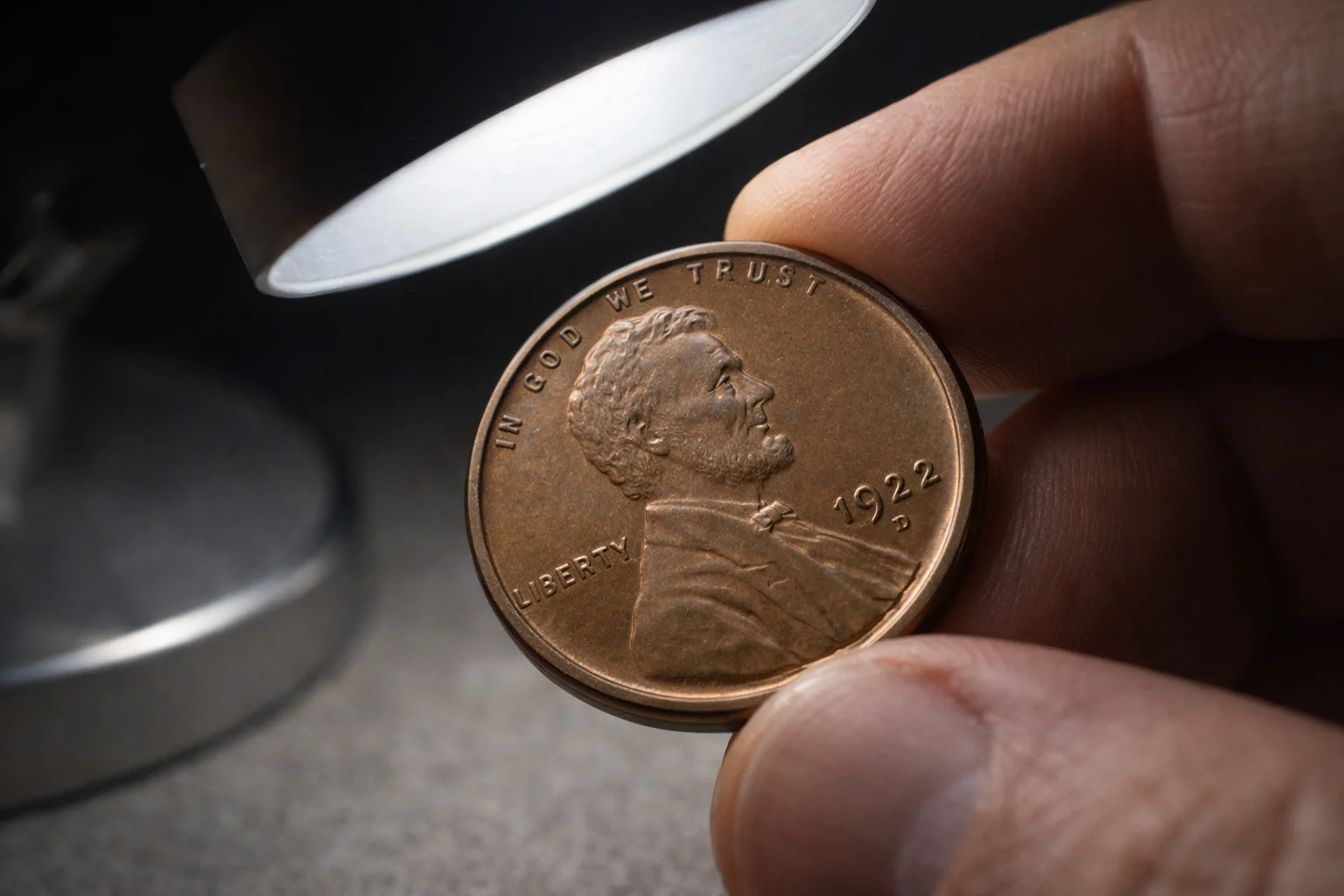
Step 1: Examine the Mint Mark Area
Look under the date. Use magnification.
- Is there a clear “D”?
- Is it faint but visible?
- Is the surface disturbed?
Removed mint marks, leave tool marks, or uneven texture. Under magnification, the area may look polished or altered.
Step 2: Check the Reverse Strength
Strong reverse:
- Bold Wheat lines.
- Clear lettering in ONE CENT.
- Sharp rims.
Weak reverse:
- Flat Wheat stalks.
- Blurry lettering.
- Soft rim detail.
This test separates weak reverse from strong reverse No D varieties.
Step 3: Compare to Known Diagnostics
Serious collectors study die pairs. Specific die cracks and markers help confirm authenticity.
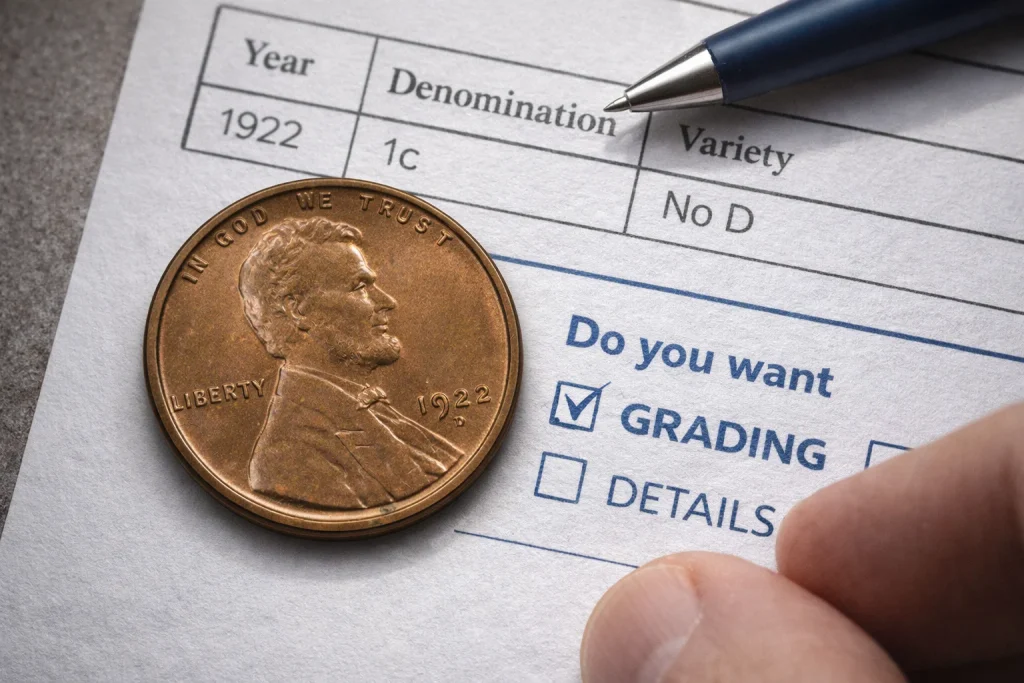
Certification is recommended for any suspected No D example.
Removed Mint Marks and Alterations
Because no D coins are valuable, altered pieces exist.
Common fraud methods:
- Grinding off the mint mark.
- Filling the area with copper-colored material.
- Tooling surfaces to hide damage.
Signs of removal:
- Color difference.
- Surface smoothing.
- Scratches under magnification.
- Metal disturbance.
Professional grading services authenticate genuine pieces.
Market Comparison Overview
The following table summarizes how the market treats each major 1922 variety. The difference is not small. It changes the entire pricing structure for the date.
| Variety | Circulated | XF | MS63 | Rarity Level |
| 1922-D Strong | Low premium | Moderate | Moderate | Common |
| 1922-D Weak | Slight premium | Moderate | Moderate | Common |
| No D Weak Rev | High | Very high | Rare | Scarce |
| No D Strong Rev | Very high | Extremely high | Rare | Key |
Regular 1922-D coins remain affordable in lower grades. Even in XF, they trade within a predictable range for early Wheat cents. MS63 examples show steady collector demand but are not rare.
The 1922-D Weak variety carries a small premium because of collector awareness, yet it does not approach key-date status. The market treats it as a minor strike issue, not a separate rarity.
The shift happens with the No D coins. Even the weak reverse type moves into a different price tier. Supply is limited. Demand is consistent. The strong reverse No D stands alone. In Mint State, it competes with recognized key dates of the series.
The gap between regular and No D coins is dramatic. Condition increases value, but correct attribution multiplies it.
Color Designations: BN, RB, RD
The 1922 cent is bronze. Surface color is a grading factor and a pricing driver. Copper reacts with air over time. Original red tone fades unless preserved carefully.
- BN (Brown): Full brown surfaces.
- RB (Red Brown): Mix of red and brown.
- RD (Red): Mostly original red luster.
Brown examples are most common. Nearly all circulated pieces fall into this category. Red Brown coins are less frequent and usually appear in higher grades. Full Red coins from 1922 are scarce due to age and storage conditions.
Red coins bring strong premiums. That premium increases sharply for rare varieties.
For No D varieties, full red examples are extremely rare. Most were spent or stored without protection. Oxidation changed the surface color over the decades.
At MS63:
- BN may bring $20,000.
- RB can exceed $30,000.
- RD examples are almost unobtainable and can set records.
These figures apply to the No D strong reverse variety. Regular 1922-D coins do not reach those levels in the same grade.
Color creates another layer of scarcity. Grade alone does not tell the full story. Surface originality and luster retention influence collector competition.
Why High Grades Are Rare
High-grade survival is limited for structural reasons. Production and handling conditions were harsh.
Several factors limit survival:
- High-speed production.
- Soft bronze alloy.
- Bag contact at the Mint.
- Circulation wear during the Depression era.
Coins were struck in large quantities and stored in heavy bags. Friction occurred before they ever left the Mint. Bronze surfaces mark easily. Even minor contact leaves visible ticks.
Many 1922 cents entered circulation during a difficult economic period. Coins changed hands frequently. Few were set aside as collectibles at the time.
Most 1922 cents saw heavy use. Few were saved in top condition. This applies to all varieties.
MS65 examples are scarce even for normal 1922-D coins. For No D, they are rare. In the upper Mint State, population reports confirm limited certified numbers. That scarcity explains the large jump in price at the highest grades.
Comparing 1922 to Other Key Lincoln Dates
The 1909-S VDB is rare due to low mintage.
The 1914-D is scarce in all grades.
The 1931-S is low mintage but widely saved.
The 1922 No D is unique. Its rarity comes from a production anomaly, not a small mintage. That distinction makes it historically important.
Final Summary
The 1922 Lincoln cent is a study in detail. One year. One mint. Four market levels.
Most 1922-D coins are collectible but not rare. Weak D examples carry moderate premiums. The No D weak reverse commands strong prices. The No D strong reverse stands as the true key variety.
Metal composition does not create value. Mintage alone does not define rarity. Strike characteristics and die history shape the market.
Small differences decide the price. In 1922, those differences could mean the gap between $20 and $30,000.
For this year, diagnostics are everything. So, should you buy or hold?
Keep a coin if:
- It matches strong reverse diagnostics.
- Surfaces are original.
- It grades XF or higher.
- Certification confirms authenticity.
Avoid:
- Cleaned examples.
- Altered mint mark pieces.
- Coins with heavy corrosion.
And remember that quality matters more than quantity.